Which gig are you running? Why the gig economy isn’t one market


-
Why isn’t the gig economy a single, unified market?
Because it spans multiple industries (e.g., transportation, healthcare, delivery, professional services) with different hiring volumes, regulations, and workforce risks—making a one-size-fits-all approach ineffective. -
What determines how a gig platform should design its screening strategy?
Two core variables: hiring velocity (high vs. low volume) and regulatory intensity (light vs. heavy), which create distinct operating realities. -
Why do screening programs fail when applied across gig sectors?
Because screening needs vary by sector—what works for high-volume delivery platforms often underperforms in highly regulated sectors like healthcare staffing. -
How can platforms identify if their screening approach is outdated?
Signs include scaling hiring without updating screening cadence, expanding globally without compliance redesign, and rising fraud signals beyond the system’s detection capability. -
What’s the most important strategic shift for gig platforms?
Move from generic “gig” assumptions to a precise understanding of their sector and operating model, then align screening and compliance accordingly.
The gig economy isn’t one market, one homogeneous sector; it’s a combination of different industries with different hiring volumes, regulations, and verification needs, and the screening setup that fits one rarely fits another. Here’s what we mean in practice.
Two of our customers each held a Monday morning meeting last month. One runs a healthcare staffing platform, placing nurses across three European countries. The other runs a last-mile delivery platform that onboarded 14,000 drivers in March alone. Both call themselves gig employers. Both run screening programs. Both, when asked what their biggest workforce risk is, gave completely different answers.
That difference is the point of this article. Most platforms recognize themselves in one of four operating realities, defined by hiring velocity and regulatory weight. If you’re responsible for hiring, screening, or compliance at a gig platform, knowing which one you actually operate in is the foundation of any other decision.
Often, “gig” is an umbrella across sectors that sit along a continuum between platform-mediated gig work and traditional staffing. There are two workforce engagement mechanisms at hand, across at least six adjacent industries.
Sectors (what the work is): transport, delivery, home services, healthcare, professional work, etc.
Delivery mechanisms (how workers are engaged): gig platforms, staffing agencies, and the overlap between them.
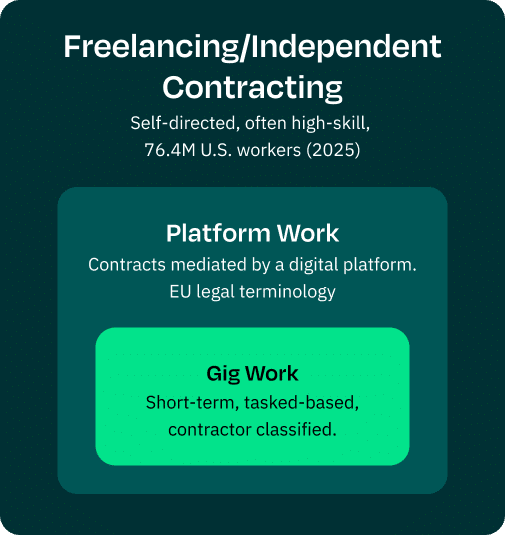
Which industries does the gig economy cover?
Gig economy doesn’t refer to a specific sector but rather a mode of engagement with a platform/ organization. It spans across sectors such as:
- Transportation: ride-hail, courier services, fleet-based delivery
- Food and grocery delivery: restaurant apps, on-demand grocery
- Professional services: freelance marketplaces for developers, designers, consultants
- Healthcare staffing: nursing platforms, locum networks, allied health
- Home services and care: cleaning, childcare, elderly care, pet care
- Retail and seasonal staffing: on-demand retail, flexible warehousing
These industries differ on the variables that matter most for screening. Hiring volumes differ by an order of magnitude. Regulatory exposure ranges from very light to very heavy. Candidate pools draw from different parts of the labor market. And the workforce risk that most concerns the compliance leader is different in each one — fraud in some, audit defensibility in others, candidate authenticity in a third, and safeguarding in a fourth. For example:
- Fraud: High-volume, lightly regulated (delivery, ride-hail): the threat is at the front door — fake applicants, synthetic identities, account sharing at scale.
- Audit defensibility: Low-volume, heavily regulated (financial services contracting, NHS locums): the question isn’t “did we catch the fraudster” but “can we prove to a regulator that we ran the right checks, correctly, every time.”
- Candidate authenticity: Professional marketplaces: is this person’s claimed expertise real, and is the person in the interview the person who’ll do the work — AI-assisted CVs, deepfake interview proxies. Distinct from fraud: fraud is an identity-at-volume problem; authenticity is a veracity-in-depth problem on individual high-stakes hires.
- Safeguarding: Home services and care: the worker enters someone’s home, looks after children or the elderly. The risk is harm to vulnerable people, which is why this sector demands the deepest record checks regardless of volume.
“Gig economy compliance” & workforce identity trust look different in each sector. The screening program that works well in one will often underperform in another.
What are the four operating realities of gig platforms?
By mapping gig employers against two variables: how fast they hire, and how heavily they’re regulated, four distinct operating realities show up. Most platforms recognize themselves within a minute:
- High-volume, lightly regulated vs. High-volume, heavily regulated
- Low-volume, heavily regulated vs. Low-volume, lightly regulated
Three signs your screening setup has outgrown its origin story
Most platforms we work with discover, when they look closely, that their screening setup was built for the platform they were two or three years ago. Three signs that this has happened are:
- Your hiring volume has outpaced your screening cadence.
- You used to run all checks at hire and assume that was enough.
- You’re now onboarding several times the volume you were three years ago, with the same one-time identity verification model.
- Continuous monitoring is either absent or running on a cadence designed for a smaller workforce.
- Your geography has outpaced your compliance setup.
- You’ve expanded into new jurisdictions, and your screening tooling is still anchored in the regulatory regime you started in. Each new market is being handled with workarounds rather than designed-for solutions.
- Your fraud signal has outpaced your detection model. You’re seeing more identity attacks than you used to, such as account sharing, document reuse, and AI-generated personas, and your existing checks weren’t designed to catch them. The fraud team is improvising at the boundary of what the screening program was built for.
The takeaway. Any one of these signs is worth taking seriously. Two together usually mean the setup needs rework, not patching.
Questions worth addressing
- Which of the six sectors do you actually compete in, beyond the label “gig”?
- Which of the four operating realities best describes how you hire today?
- When was your current screening program designed, and was it designed for the platform you were then, or the platform you are now?
- Who in your business would be in the room if you had to redesign your screening approach from scratch? Is anyone missing?
The most useful thing you can do isn’t to adopt anyone’s framework. It’s to be specific about which gig business you actually run, and to look at your screening program through that lens.
Know your people™


Along the candidate journey HR teams choose First Advantage for consistent screening, fast verifications, and support of compliance regulations.
- 200M screens annually
- 1B+ records in proprietary databases
- 200+ countries and territories


This content is offered for informational purposes only. First Advantage is not a law firm, and this content does not, and is not intended to, constitute legal advice. Information in this may not constitute the most up-to-date legal or other information.
Readers of this content should contact their own legal advisors concerning for their particular circumstance. No reader, or user of this content, should act or refrain from acting on the basis of information in this content. Only your individual attorney or legal advisor can provide assurances that the information contained herein – and your interpretation of it – is applicable or appropriate to your particular situation. Use of, and access to, this content does not create an attorney-client relationship between the reader, or user of this presentation and First Advantage.
