In the background screening industry, we talk a lot about the ease and efficiency of applicant tracking systems (ATS), and how they can help streamline hiring for both candidates and employers. Today, we’re expanding the conversation to share how they can also be used for process improvement since they can reveal how and where candidates are progressing—or getting stuck—in their hiring journey.
The value of centralizing hiring data within a single online system.
By automating and digitizing many of the manual, paper-driven processes in hiring, an ATS can help preserve a company’s HR resources, enabling it to more strategically focus its time, money and staff on creating a better candidate experience. When background checks are integrated into an ATS, it further simplifies the process by unifying multiple hiring tasks within a single online system. This provides visibility into and across the hiring timeline since data can be electronically captured and analyzed from things like recruiting, online applications, background screening, candidate communications and more.
Process transparency can reveal strengths—and weaknesses.
When an ATS is used well, it’s easy to pull and analyze high-quality, time-stamp data for candidates moving through the hiring process. Companies that use ATS tracking methods consistently have an advantage when looking for opportunities to improve and speed up the hiring process. It can be surprising when the data shows which hiring steps are taking the longest. In fact, good measurement can completely change the focus of a time-to-hire reduction project.
Case Study: Intelligently target and adjust specific hiring steps.
To illustrate the level of process improvement insights that can be derived from ATS data, the following graph shows the amount of time candidates from one company spent in each phase of the hiring process. As mentioned earlier, an ATS can provide these important date- and time-stamps for deeper analysis.
For example, this company was able to pinpoint that the duration of its background screening process actually shrank from 6 days to 4.7. But the approximate time savings were counterbalanced by increases in the application rates and actual start dates.
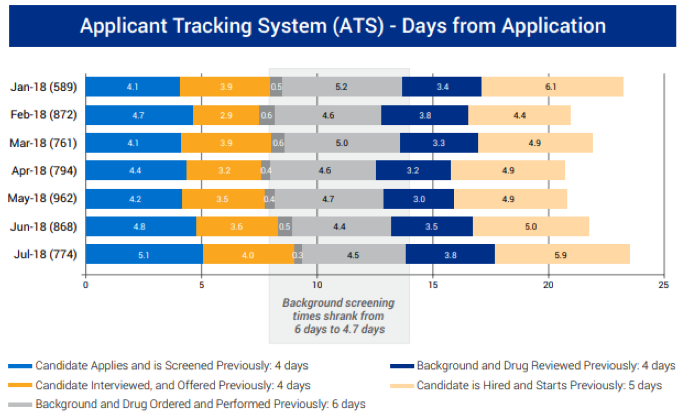
By clearly seeing which steps are taking the longest amount of time, companies can intelligently target and adjust specific parts of the hiring process to more effectively:
- Speed up hiring
- Optimize administrative efficiency
- Improve the candidate experience
When you can do all that, you can better compete for—and win—the best talent.
At First Advantage, we’re here to help. Get in touch today to discuss this idea and other ways we can leverage technology and data to help you better manage risk and hire the best talent.